Dolmabahçe Palace The
Empire’s Last Grand Statement
Dolmabahçe Palace stands as the Ottoman Empire’s final grand architectural statement on the shores of the Bosphorus. Blending European opulence with imperial tradition, the palace reflects a moment of transition, power and elegance at the twilight of an empire. Today, it remains one of Istanbul’s most striking symbols of history, refinement and change.
Dolmabahce Palace Tickets with Fast Track Entry & Audio Guide
Explore this experience →An Empire at the Edge of the Bosphorus
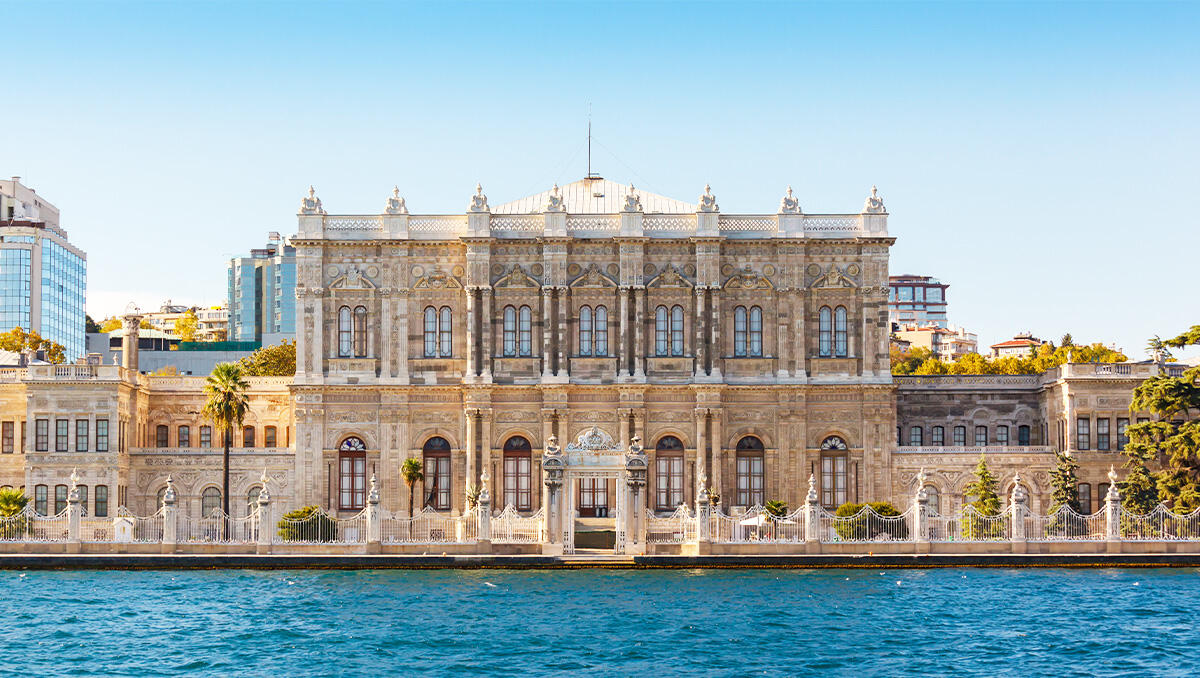
There are palaces that protect power behind high walls. And there are palaces that present power openly, almost theatrically. Dolmabahçe Palace belongs to the second kind. Rising along the European shore of the Bosphorus, it does not hide in courtyards or turn inward. It faces the water directly, as if aware that it was meant to be seen.
When Sultan Abdülmecid I commissioned the palace in the mid nineteenth century, the Ottoman Empire was navigating reform, pressure, and change. The world was shifting. Diplomacy required new symbols. Representation mattered more than ever. Dolmabahçe was conceived not simply as a residence, but as a visible statement that the empire could stand alongside European powers in scale, elegance, and ambition.
Completed in 1856, the palace marked a decisive departure from the spatial logic of Topkapı Palace. Instead of layered courtyards and intimate pavilions, visitors encountered grand corridors, monumental halls, and a symmetry inspired by European architectural traditions. Yet despite these influences, Dolmabahçe never abandoned its Ottoman identity. It merged worlds rather than replacing one with the other.
A Waterfront Declaration
The façade stretches for hundreds of meters along the Bosphorus. Arriving by boat, foreign envoys would have seen a structure that mirrored European royal residences in proportion and rhythm. The setting amplified its impact. The palace did not sit above the city. It engaged directly with the strait, the water reflecting its scale and light.
This orientation toward the Bosphorus was intentional. In the nineteenth century, diplomacy unfolded as spectacle. The empire needed a backdrop that communicated stability and refinement. Dolmabahçe delivered both.
The gates themselves feel ceremonial. Passing through them creates a subtle shift in atmosphere. The noise of the city softens. The gardens introduce order before the interiors expand into something far more dramatic.
Inside the Palace
Dolmabahçe Palace contains 285 rooms and 46 halls. Numbers, however, cannot capture the experience of walking through it. Ceilings rise unexpectedly high. Light enters through tall windows and moves slowly across polished floors. The famous crystal staircase curves with precision, creating a sense of movement even in stillness.
The Ceremonial Hall stands at the center of the complex. It was here that sultans received foreign dignitaries and hosted significant state occasions. The space is vast. Its dome draws the eye upward. A monumental chandelier hangs above, anchoring the room in quiet gravity. Conversations that once took place here would have carried political weight far beyond these walls.
Decoration throughout the palace reflects meticulous craftsmanship. Intricate ceiling paintings, carved details, expansive mirrors, and layered textures reveal the resources invested in its construction. The aesthetic choices were deliberate. They conveyed continuity with Ottoman artistry while acknowledging European tastes of the era.
The Selamlık and the Harem
Like earlier Ottoman palaces, Dolmabahçe is divided into distinct sections. The Selamlık served as the administrative and ceremonial wing, where official duties were carried out. It projected authority, discipline, and order.
The Harem, by contrast, functioned as the private domain of the imperial family. Its atmosphere feels more intimate. Corridors narrow slightly. Rooms become less imposing and more personal. Yet even here, the scale remains generous. The palace never fully retreats into modesty. It maintains a quiet confidence in every corner.
Together, these sections reveal how the empire balanced public image and private life within a single architectural vision.
A Palace at the Edge of an Era
Dolmabahçe is often described as the empire’s last grand statement. The phrase carries emotional weight because it reflects historical reality. The palace was completed during a period of reform and financial strain. Its construction symbolized aspiration, but it also foreshadowed the complexities ahead.
In the early twentieth century, the palace witnessed another transformation. After the establishment of the Republic of Turkey, Mustafa Kemal Atatürk used Dolmabahçe as a presidential residence during his visits to Istanbul. He spent his final days here in 1938. The clocks in the room where he passed away remain set to 9:05, preserving a moment that marked the end of one life and the consolidation of a new chapter in national history.
In this sense, Dolmabahçe bridges two worlds. It embodies the late Ottoman desire for visibility and reform, while also standing as a silent witness to the birth of modern Turkey.
Walking Slowly Through History
To explore Dolmabahçe Palace today is to move through layers of ambition, uncertainty, and vision. The Bosphorus glimmers just beyond the windows. Seagulls pass overhead. The rhythm of contemporary Istanbul continues outside, yet inside the palace, time feels measured and deliberate.
This is not a space that overwhelms with noise. Its power lies in proportion, in detail, in the way corridors unfold gradually. Every hall suggests intention. Every doorway frames another perspective. The palace does not simply tell the story of rulers. It tells the story of transition.
Dolmabahçe Palace remains one of Istanbul’s most compelling landmarks not only because of its scale or ornamentation, but because of what it represents. It captures the precise moment when an empire sought to redefine itself in a rapidly changing world.
Standing at the edge of the Bosphorus, it continues to face outward, just as it did in the nineteenth century. A structure built to be seen. A residence built to be remembered. A final grand statement that still echoes across the water.